Design Your Unique Value Proposition
Overview
Designing your UVP is a focused exercise that translates the foundation you've built into a clear statement. This process takes the individual elements of your work and shapes them into language your audience and funders can understand quickly.
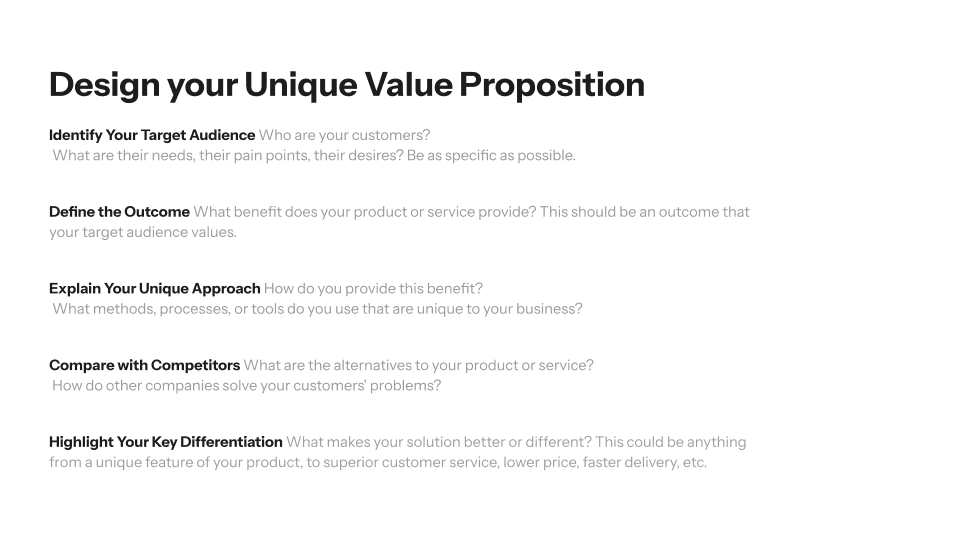
Identify the Audience You Serve
Start by naming the specific group your work centers. Your UVP speaks directly to this audience, so precision matters here.
Ask yourself:
Who engages with your work today?
Who benefits most from what you offer?
What shared characteristics or circumstances define this group?
The more specific you are about your audience, the stronger your positioning becomes.
Define the Outcome They Want
Your audience is looking for a result, not a feature. Identify the meaningful shift or experience they are seeking, i.e., the change that matters to them.
It should answer the question: What does success look like for the people you serve?
Examples of outcomes:
Reduced financial stress and increased savings
Faster access to affordable housing
Improved health outcomes with less administrative burden
Starting with the outcome your audience cares about and grounds your value in what matters most to them.
Articulate Your Approach
Your method, model, or process shows how you create value. Consider:
What methods do you use consistently?
Is your approach rooted in community partnership, data-driven insight, lived experience, or technical innovation?
What parts of your delivery set the tone for how people experience your work?
Your approach is what makes your solution yours. It reveals how you interpret the problem and what you bring to solving it.
Understand the Alternatives
Consider what other solutions or providers your audience could turn to instead of you.
Knowing where competitors focus helps you identify where your work fits distinctly.
Ask yourself:
What other solutions exist for this problem?
How do competitors or peers approach this work?
What do they emphasize, and where do they fall short?
A clear picture of existing options makes it easier to explain where you fit and what you uniquely provide.
Highlight What Sets You Apart
Your differentiation often lives in something straightforward: how you deliver your work, the type of support you offer, your values, or the experience you create.
Choose the elements that consistently show up in your results and feedback. These details give your UVP shape and substance.
Example:
An organization offering financial coaching for creatives stands out by simplifying complex concepts through visual tools and step-by-step templates designed for how creatives think and work. They differentiate through culturally adapted financial literacy that meets creatives where they are.
Bringing It Together
Use these five components to shape a UVP that reflects the substance of your work (You can also create your own.):
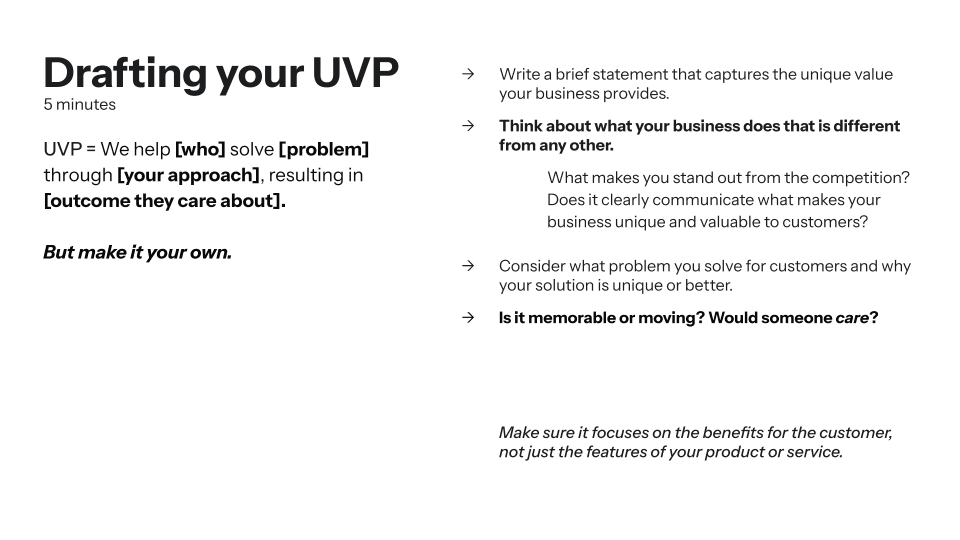
[Audience] + [Outcome] + [Approach] + [Differentiation]
or
We help [who] solve [problem] through [your approach], resulting in [outcome they care about].
What Comes Next
The next lesson explores why this message matters across every part of your work, from grant proposals to strategic partnerships to customer engagement. Your UVP becomes the through-line that makes your entire story coherent.