Section V — Budget Breakdown
Overview
Funders use your budget to assess whether you understand the real cost of your work. A well-structured budget connects each expense to a specific activity, reflects actual implementation needs, and demonstrates financial competence.
In this lesson, you'll learn:
The two main parts of any grant budget
How to structure direct and indirect costs
What funders look for in a realistic budget
How to build your own budget step-by-step
What a Grant Budget Does
Your budget serves four core functions:
Shows how funds will be used during the grant period
Connects each cost to a specific activity in your proposal
Reflects real implementation needs (staffing, materials, outreach, technology, evaluation)
Demonstrates organized, responsible financial planning
Funders expect budgets that are realistic, precise, and easy to understand.
The Two Main Parts of Any Grant Budget
Income / Revenue
All funding sources that support the project appear in your income section.
For the GridEdge EPIC example, the income is a single $150,000 request. If you have multiple sources (i.e., matching funds, donations, or in-kind support), list each one here.
Key Rule: Total income should equal total expenses.
Expenses
Expenses fall into two categories:
Direct Costs — Costs tied directly to implementation
Examples: staff time, equipment, sensors, outreach materials, evaluation work
Indirect Costs — Administrative support
Examples: management time, reporting, insurance, general operations
Include both unless the funder's guidelines state otherwise.
GridEdge AI Budget Example ($150,000)
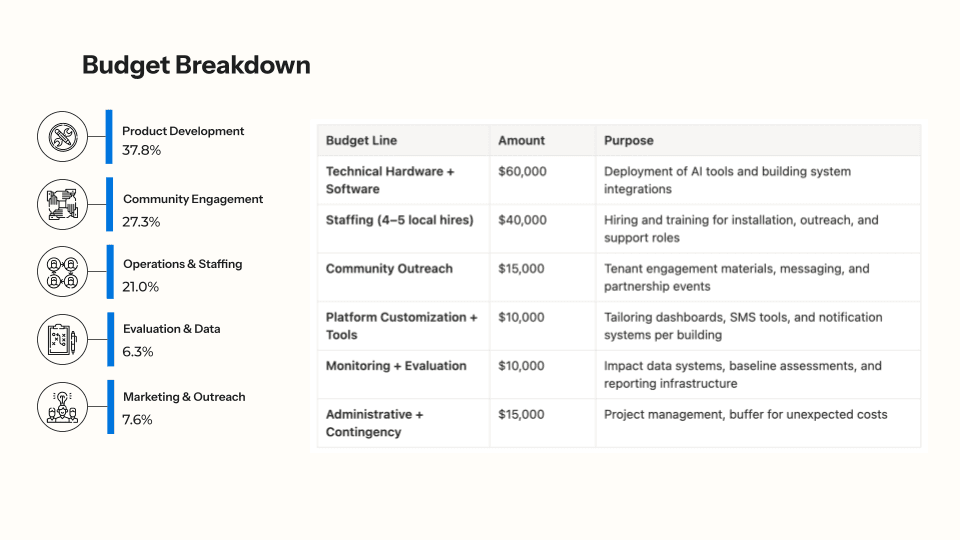
Here's how GridEdge AI structured their fictional EPIC grant request:
Direct Costs ($135,000)
Technical Hardware + Software: $60,000
Tools, dashboards, load-balancing integrationsStaffing (4-5 community hires): $40,000
Installation, coordination, resident supportCommunity Outreach: $15,000
Messaging, multilingual materials, tenant sessionsPlatform Customization: $10,000
Tailored dashboards, reporting setupMonitoring + Evaluation: $10,000
Data analysis, baseline metrics, reporting infrastructure
Indirect Costs ($15,000)
Administrative + Contingency: $15,000
Project management, compliance tasks, operational buffer
Total Expenses: $150,000
Total Income: $150,000
Key Budget Principles
💰 Match costs to activities – If you list staffing, your methods section must explain what those staff will do.
If you request hardware, show how it will be used in your plan.
📊 Ground numbers in reality – Use actual salary ranges, vendor quotes, market data, or standard tools in your field. Avoid inflated or generic estimates.
✂️ Keep categories simple – Use clear labels: staffing, equipment, outreach, training, evaluation, administrative costs. Funders appreciate budgets that are easy to follow.
🛡️ Build in a buffer – Many organizations include a 5-10% contingency to account for unexpected needs.
A small buffer supports realistic planning without appearing careless.
How to Build Your Own Budget
Follow these steps to create a funder-ready budget:
☐ Step 1: List your key activities
Every activity you describe in the methods section should appear in your budget.
☐ Step 2: Assign a cost to each activity
Consider materials, tools, software, salaries, contractors, data needs, and outreach expenses.
☐ Step 3: Separate direct and indirect costs
Direct costs support implementation. Indirect costs support administration.
☐ Step 4: Add a budget narrative
A budget narrative is a brief written explanation that accompanies a grant budget and shows how each cost supports the work you plan to do. It clarifies what you’re spending money on, why each item is necessary, and how you arrived at the amounts. Instead of repeating the budget table, it gives context so reviewers understand the logic behind the numbers.
Check out this example here.
☐ Step 5: Balance your budget
Make sure total income equals total expenses. A balanced budget shows financial competence.
Common Mistake: Listing expenses without connecting them to specific activities in your proposal. Reviewers will notice the disconnect and question whether you've thought through implementation.
What's Next
The next lesson covers how to write a budget narrative that connects each line item to your story and strengthens your case for funding.